
Label core size, roll diameter and labels per roll
Start with the core opening and the maximum roll diameter your applicator accepts. Then confirm unwind and labels per roll with your operator and converter.
THE SHORT ANSWER
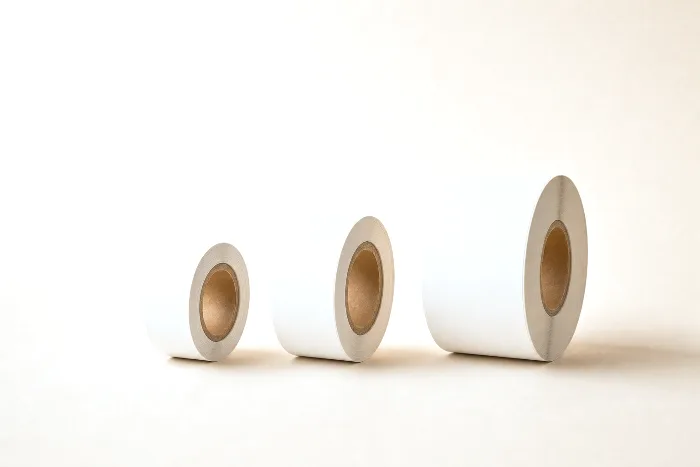
Label core size is the inner diameter of the opening that fits over the equipment spindle. Measure the full wound roll separately: its outside diameter must also fit the applicator. Confirm both dimensions with the operator before agreeing the unwind, count and tolerances with the converter.
What should a label roll specification include?
A label can be the right size and still arrive on a roll that does not fit your line. Record the exact applicator or printer model. Ask the operator to confirm the core opening, maximum roll diameter, adapters and feed direction before ordering.
Keep a roll drawing with the approved job specification. A purchase order that says only “3-inch core” leaves outside diameter, web width, unwind and other important requirements unresolved.
The roll specifications to confirm before ordering
| Field | Record | Confirm with |
|---|---|---|
| Core inner diameter (ID) | Bore diameter with units; approved adapter if used | Equipment manual and operator |
| Maximum roll outer diameter (OD) | Allowed roll diameter, weight and handling limits | Operator and equipment specification |
| Web and label dimensions | Liner width, finished label dimensions, feed direction and gap | Converter and operator |
| Unwind | Face in/out, leading artwork edge and annotated diagram | Converter and co-packer using the same chart |
| Labels per roll | Requested count, permitted variation and partial-roll policy | Converter within the approved machine limits |
| Handling details | Splice policy, leaders/trailers, roll identification and packaging | Converter and receiving/application team |
State units beside every dimension. Three inches is 76.2 mm; one inch is 25.4 mm. Those conversions do not establish which core your machine accepts.
Core inner diameter determines spindle fit
Core ID is the opening through the center of the core. Match it to the specified spindle or approved adapter. Core outside diameter includes the core wall and is a different measurement. Do not substitute one for the other in an order or roll-capacity estimate.
There is no universal core size for all label equipment. For example, Primera's AP380 manual lists a 2–3 inch supply-roll core ID and an 8 inch maximum supply-roll diameter. That is a model-specific example, not a specification for your line. Check the manual and the operator's setup before buying.
Also confirm core width and condition requirements where specified. An adapter, damaged core or unsupported roll can change how the roll mounts and feeds. Have the operator resolve fit before approving production.
Roll diameter and labels per roll are related, but different
Roll OD is measured across the full wound roll. It must stay within the equipment's approved limits. Labels per roll also depends on the usable wound length and the label dimension along the feed direction plus the gap. That dimension may be the artwork's width or height, depending on the unwind.
For 1,000 labels, allow about 2,125 inches (177.1 feet) for 1,000 pitches, plus any specified leaders, trailers or other allowance. This estimates web length; it does not determine the finished roll diameter.
Estimating OD from web length also requires the core outside diameter and effective wound thickness, including the liner and finished label construction. Material variation, gaps, winding and allowances affect the result. Ask the converter to confirm the count and diameter together, with tolerances, rather than treating a geometric estimate as an exact production count.
If the requested count exceeds the approved OD or weight, agree smaller rolls or a different permitted configuration with the operator. Do not simply request the largest possible roll: loading, tension, handling and production scheduling may favor another count.
Match rolls to the actual application method
- Hand application: confirm roll size and presentation with the person applying the labels or using the dispenser.
- Desktop printing: confirm media dimensions, sensor requirements and compatibility with the printing method and any ribbon.
- Semi-automatic or automatic application: obtain the model's roll specification and the operator's setup requirements, including roll weight and splice limits where applicable.
- Co-packer application: identify the receiving site and line. Do not assume another co-packer, or another line at the same site, uses the same specification.
For a supplier change or new construction, agree whether a sample roll and line trial are needed before the full run. See label application methods for planning the handoff.
Confirm face orientation and the leading artwork edge
State whether the labels are wound with the printed face outward or inward, then identify the edge that leads as the label leaves the roll. Use an annotated artwork thumbnail or approved drawing so “top first” has a clear reference.
Numbered unwind charts are useful only when both parties use the same convention. Confirm the number against the converter's chart and the applicator operator's drawing. See the roll direction and unwind guide; keep the signed-off diagram with the SKU specification.
Separate roll capacity from feed problems
If rolls empty too frequently, first record actual labels per roll, production consumption and changeover time. Review a higher count only within the approved OD, weight and handling limits. A roll with more labels is not automatically suitable for the line.
If the machine misfeeds, document where it stops and ask the operator to check mounting, unwind, web width, spacing, sensors, tension, splices and label release. Correct core and unwind values alone do not rule out other roll or material defects. Follow the machine's safe operating procedure; use the applicator troubleshooting guide to organize the observations.
- Obtain the current equipment specification and operator approval.
- Record the complete construction and roll drawing.
- Have the converter confirm feasible count, OD and tolerances.
- Agree the sample or line trial and acceptance criteria.
- Keep approved samples, revisions and receiving checks with the order.
Prepare the roll handoff for your packOS quote
Use the label SKU schedule to identify each artwork revision, quantity, release and destination. Attach or share the approved roll drawing through the agreed supplier handoff; do not assume the artwork file itself contains the machine requirements.
Ask the supplier to confirm core ID, maximum OD, web width, unwind, count, tolerances and any splice or partial-roll policy in the final specification. A quote or digital artwork proof is not a line-trial approval.
Start a label quote with the known details, then use the enterprise roll-label buying guide for the wider program. Return to the label printing checklist to coordinate artwork, material, application and delivery approvals.
Frequently asked questions
What is label roll core size?
Core size usually refers to the inner diameter of the core opening. Confirm that meaning and the units on the order. Match the core ID to the equipment spindle or approved adapter; core outside diameter is a different measurement.
Should I order a 1-inch or 3-inch label core?
Use the exact equipment specification and operator approval. Neither size is universal. Confirm the model, current setup and any approved adapter before ordering.
How many labels fit on a roll?
The count depends on the usable wound length and the label dimension along the feed plus the gap. The final roll diameter also depends on core outside diameter, construction thickness, winding and allowances. Have the converter confirm count and OD together with tolerances.
Does label width or height determine labels per roll?
Use the label dimension along the feed direction. It may be the artwork width or height, depending on the unwind. Add the gap to get the pitch; label dimensions alone do not determine roll diameter.
Should I order the largest roll my applicator accepts?
Not automatically. Stay within the approved diameter, weight and handling limits, and agree a count that works for loading, tension and production scheduling. Confirm the proposed roll with the operator.
What unwind direction should I specify?
State printed face inward or outward and the artwork edge that leads off the roll. Include an annotated drawing and confirm any position number against the supplier chart and operator requirements.
What should I send a co-packer before ordering labels?
Send the construction, finished label and web dimensions, core ID, maximum OD, unwind drawing, proposed count, tolerances and splice policy. Ask the named site and line operator to approve the specification and any required sample trial.